
Laur P
Regurgitalites
From Sept 17 to Oct 31 , 2026
Galerie Nicolas Robert is pleased to present Regurgitalites, an exhibition of the most recent series of paintings by Laur P. Working with layered, dry-brushed paint that continually buries and resurfaces its own history, the artist treats the painted surface as both a sedimentary and a digestive plane — a body that absorbs, transforms, and expels its material and psychic traces.
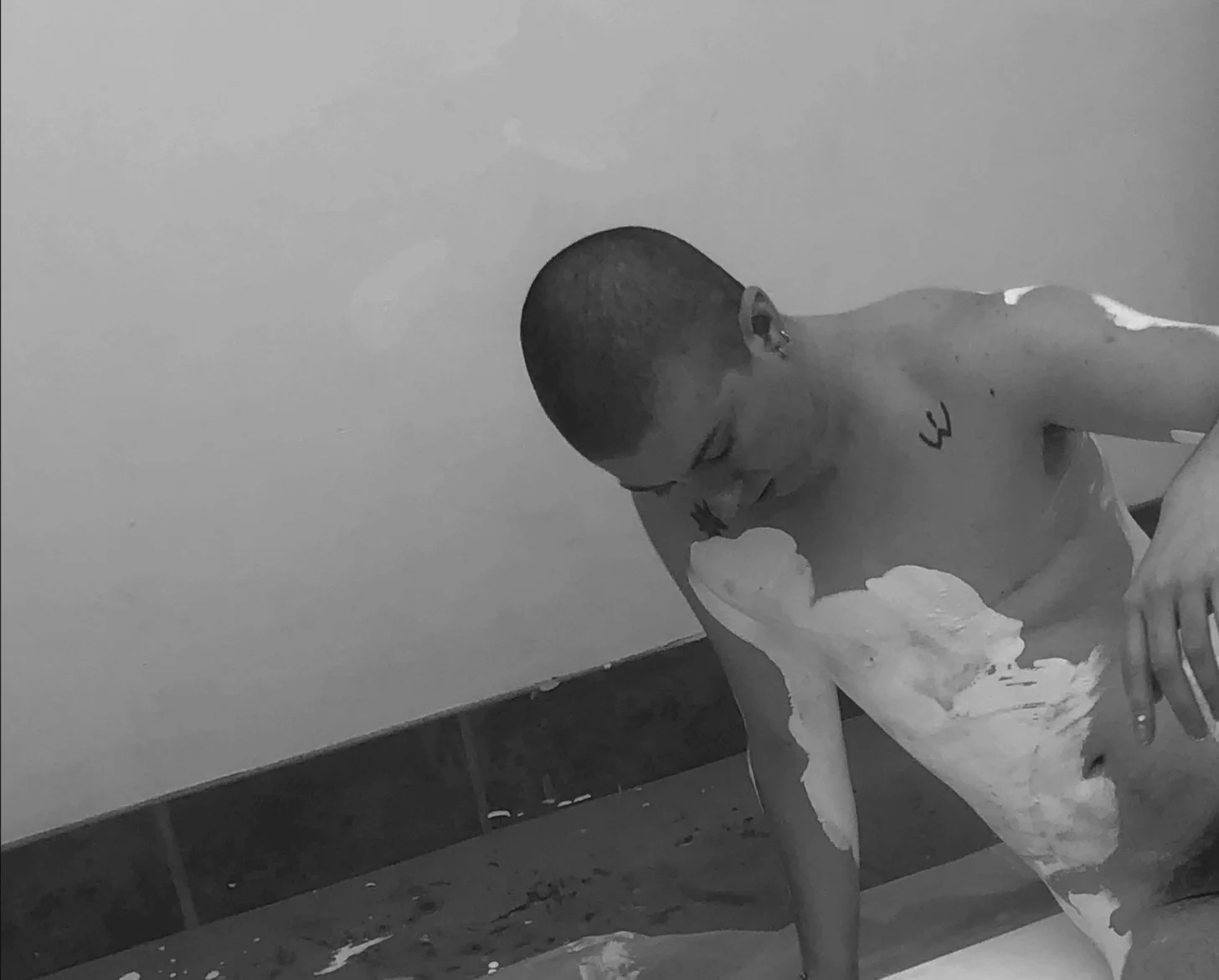
For this exhibition, the artist enlisted nineteen trans participants (including himself, close friends and his romantic partner), to press different areas of their bodies into the gessoed surface of the paintings to begin, typically three to four participants per work. The wet gesso puckers, patterns and records the contours of these impressions, and the resulting marks become the starting point the artist works throughout the composition. In the finished paintings, these traces are rarely recognizable as bodies; instead they surface as organic, biomorphic forms, each are layered and superimposed until individual traces dissolve into collective, ambiguous compositions akin to what paleontologists call “fossil problematica”: specimens that resist clean classification.
Central to the new works are what Laur P calls “pictorial fossils”: forms that emerge, vanish, and reappear through the accumulation of paint, a pictorial state resulting from gestures of burial and excavation. Here, the figure of the fossil is a conceptual approach through which the artist reflects on notions such as extinction, monstrosity, haunting, and queer, trans, and crip corporealities. By approaching abstraction as a speculative, even geological, mode of vision, Laur P uses painting to reveal traces and forms that elude humanist frameworks, particularly with regard to representation and perception.
The exhibition’s title draws on regurgitalites, the paleontological term for fossilized vomit and a category the artist connects to Julia Kristeva’s theory of abjection. Vomit, for Laur P, is a potent image of the body’s fragile boundaries: something expelled that nonetheless lingers, refusing a clean separation between self and other, inside and outside. Read alongside death-assemblage fossils, or thanatocoenoses, this imagery becomes a way of holding both the threat of erasure and the possibility of transformation. Decomposition as a condition for re-composition, fragmentation as an opening toward the future with new relational forms. Regurgitalites positions abstraction not as a retreat from meaning but as a speculative tool — a way of imagining what resists direct visual or categorical access. The result is a body of work that refuses resolution, holding open a space between rejection and preservation, damage and potential.